
ENERGY MANAGEMENT ON CAMPUS
Chula Vista Elementary School District
 Solar Consulting Services
Chula Vista Elementary School District hired EcoMotion in February 2019 to provide a comprehensive solar and storage feasibility study for each of its 47 campuses and facilities. EcoMotion reported to CVESD’s board that the 8.1 MW project would save $66 – 88 million depending on how it was financed. In March 2020, the District was awarded bonding authority for the project, allowing for 100% solar at every campus and with no money down enabling over $80 million in savings over a 25-year period. The project also involves a solar-powered microgrid at the District Office to back up critical communications and IT systems.
To frame up the project, EcoMotion completed analysis of interval bill data, SDG&E rate structures and time-of-use periods, as well as spatial and financial analysis of all sites. With Board enthusiasm, EcoMotion spearheaded the effort to develop an RFP, to identify suitable firms for installation, and managed the procurement process. In the midst of a pandemic, EcoMotion facilitated a virtual proposers conference for the solar project. With thirteen firms in attendance, EcoMotion showcased all 49 campuses. All systems are now built and interconnected. Currently, EcoMotion tracks system performance through Engie’s Utility Vision system to assure each array’s operation and to measure each system’s performance.
Electric Buses and Charging Infrastructure
EcoMotion also supported the Chula Vista Elementary School District with its Ebus program. The District was granted a California Energy Commission budget for 10, V2G capable Ebuses. EcoMotion’s work involved helping the District select and procure 10 new BlueBird electric buses, plus 10 fast charging stations, and management software. EcoMotion’s role also involved working with San Diego Gas & Electric to upgrade the electrical infrastructure at the transportation yard to allow for the fast charging, as well as future expansion. The ten, 100 kW DC level three fast chargers can fully charge a bus in about 40 minutes.
EcoMotion also introduced CVESD to the Low Carbon Fuel Standard (LCFS) credits program of the California Energy Commission. The LCFS is designed to decrease the carbon intensity of California’s transportation through this “fee-bate program.” Thanks to its solar, Ebus charging, EcoMotion pointed the District to the Zero Carbon Intensity Pathway of the LCSF program.
Fremont Unified School District - Solar and Storage Analysis
In 2022, EcoMotion supported facilities officials at the Fremont Unified School District in its evaluation of two proposals for solar and storage. The proposals were each strong; one presented by Tesla and the other by Forefront. The analysis considered solar and storage at each of the District’s campuses. EcoMotion’s work culminated in a Board presentation with an objective review of the District’s options as well as EcoMotion’s recommendations.
Campbell Union High School District - Energy Resilience
After successfully bringing microgrids and their energy resilience to Santa Rita Union School District in Salinas, California, in 2017 Campbell Union High School District – in the San Jose area – reached out to EcoMotion for energy resilience. How could its seven campuses remain operational in the event of a blackout, and even in the event of a sustained power outage?
Representing the District, and through a competitive solicitation, EcoMotion developed a team of leading firms to build microgrids for each campus. They would be powered by the sun. The team included Johnson Controls, Avalon Batteries, Eaton, and Spirae. The job was to create a model of resilience using existing solar coupled with vanadium-flow battery storage, managed by sophisticated controls. Each community feeding into the school district supported the project; West Valley College was a project partner.
EcoMotion then worked with the District to match funds and secure an EPIC grant from the California Energy Commission for the project. We later applied for and requested funding from the Federal Emergency Management Agency through the Hazard Mitigation Grants Program. Through the District partnership, and technical development process, EcoMotion began to develop a template for “rewiring” California campuses such that their solar assets – when combined with storage and controls – are vital during power outages.
Huntington Beach City School District – Solar Forensic Analysis
For Huntington Beach City School District, EcoMotion performed a full solar forensic analysis of two sets of aging solar arrays there. The new facilities director wanted a complete review of their operations and value to the District, and to know whether costly maintenance was warranted. The systems were installed in 2010 by Chevron at a cost of $7.28 million, and in 2011 at a cost of $7.5 million. EcoMotion examined the solar systems on each campus in detail, taking note of conditions and identifying broken panels in the process.
This site evaluation was then coupled with detailed evaluation of the monitoring system and the solar arrays’ performance. EcoMotion was able to easily tell which arrays were the best and worst performers. The financial analysis revealed how the Edison rates have actually escalated, and how the performance guarantees had been met, largely by banking early solar production prior to the contract effective date. EcoMotion provided detailed financials and recommendations to the District.
Mountain View School District - Solar Works
Mountain View School District had been through a failed solar process the year before, and called EcoMotion to resuscitate the District’s desire for solar. EcoMotion was hired to serve as the District’s owners representative and began with a thorough, impartial feasibility analysis. With Board approval, this led to a procurement process for the ten-campus project. EcoMotion is currently providing project oversight and quality control, working on behalf of the District with Luminace on installation, complicated by trees, easements, and tight summer schedules on several campuses.
Orange Unified School District - Solar Works
For Orange Unified School District, EcoMotion twice served as subject matter expert in procurement processes for solar power, the first for 13 campuses in 2018, and the second for 10 campuses in 2020. EcoMotion worked with OUSD officials to determine the locations for solar, followed by independent financial analysis of the value of solar at each site. EcoMotion crafted Requests for Proposals and helped the District evaluate proposers, and contract with them.
The Fall 2020 solicitation featured a successful Virtual Solar System Job Walk. EcoMotion’s two-hour, online job walk presented the District’s specifications for each site, proposed array and meter locations, and construction coordination details. EcoMotion presented aerial and photographic images, reinforced with a Google Drive complete with comprehensive site plans, utility interval data, etc. In each case, Ameresco was selected to finance, build, own, and operate on behalf of the District and through a power purchase agreement.
EcoMotion has also provided performance monitoring and verification services of its two sets of solar arrays for OUSD. Once the first set of campuses were outfitted with solar, EcoMotion analyzed the performance of these eight solar systems. This was Board direction: Before moving forward with solar on another 12 sites, the Board wanted to be sure of system performance and that all schools have been properly migrated to the correct utility rate. With access to billing data, EcoMotion assessed each site and flagged discrepancies in performance and rate structures.
Park Century School – Solar and Storage
For the Park Century School, EcoMotion serves as a solar and storage advisor. The school has been adding a multipurpose facility, sandwiched in a pizza pie shape between two facilities, one of its own. The design includes subterranean parking – with stacked cars tied to EV chargers, outdoor areas and multipurpose rooms. A large solar awning was envisioned by John Berry Architects. EcoMotion worked with John Berry and his associates advising on solar configurations and technologies. We examined several architectural glass products. Later our team calculated the solar performance of different designs. The storage analysis was tricky given space constraints and the option of night-time charging for the community.
Rescue Union School District - Solar Support Services
In December 2022, EcoMotion received a call from Rescue Union School District officials about the prospect of helping the District go solar in time to maintain the benefits of Net Energy Metering 2. By April 14, 2023, the District would have to be comfortable with the feasibility of going solar using a power purchase agreement (PPA). It would have to have gone through a competitive solicitation to select a contractor, have a contract finalized, and have the contractor finalize each campus’s design to submit before the deadline. Many pieces had to align, and did. EcoMotion managed the process and met the deadline.
EcoMotion’s Energy Efficiency Works
Over the past seven years, EcoMotion has managed energy efficiency projects for campuses worth $27+ million dollars, ~$33 million with associated solar and storage systems.
This brief compiles data from 100 California campuses where EcoMotion has served as an energy manager. Much of this work was paid by California Proposition 39, a 2013 bill that taxed out-of-state corporations doing business in California and put the money to work upgrading public schools and community colleges.
LED lighting is certainly the retrofit of the decade, often cutting lighting energy use by 50%. It’s the most cost-effective and pervasive retrofit that EcoMotion has specified and managed of late. EcoMotion has done lighting projects with 18 districts and charter schools managing the retrofit of 57,153 fixtures.
Far less sexy and less cost-effective are important HVAC upgrades: heating, ventilating, and air conditioning. EcoMotion has managed the replacement of 272 rooftop and wall-mounted HVAC units for a combined 406.6 tons. EcoMotion has also been involved in chiller upgrades, as well as boiler replacements and air handler repairs. For two school districts, EcoMotion installed wireless thermostat systems, in one a direct control ventilation system tied to CO2 levels of occupants, as well as a cool roof.
Much of the work was done with retro-commissioning campuses and installing 57 energy management dashboards to make vivid both energy use and savings.
In addition, EcoMotion has been involved in retrofitting pool pumps, heaters, and covers. Along the way EcoMotion helped two schools get electric buses. For eight schools that had tapped out their most pressing efficiency opportunities, EcoMotion helped them get them solar, mostly small systems for charter schools that couldn’t afford them and that are not eligible for financing. The most comprehensive work involved the Santa Rita Union School District, where EcoMotion supported energy-efficient lighting and wireless thermostat controls and then financed and installed 1 MW of solar + 480 kW of storage plus microgrid controls over six campuses.
Pathways to Carbon Neutrality Plan for the Marine and Science Technology Academy - Miami, Florida
EcoMotion developed a Pathways to Carbon Neutrality Plan for the Marine and Science Technology Academy (MAST) in Miami, Florida. The Plan salutes early works with sustainability, notably energy efficiency, renewable energy, and sustainability at MAST. EcoMotion investigated the facility and transportation energy use, presented MAST with pathways to carbon neutrality to consider, addressed financing options, and ultimately presented recommendations for additional steps in both governance and operations. In moving the existing foundation forward, the Plan prepares the School for the carbon-free energy future.
Glendale Community College District Energy Strategy Validation Study
Glendale Community College District hired EcoMotion to analyze its proposed fuel cell energy strategy. EcoMotion evaluated the economic benefits and environmental implications of the proposal, and made recommendations on two energy pathways forward, a fuel cell option and an alternate solar option. The Energy Strategy Validation Study conducted by EcoMotion included financial and emissions analyses based on rates and marginal power plant over 25 years. The study concludes with a series of recommendations. In the short term, yes, given current utility rates…take the fuel cell option. In the long term, EcoMotion recommends action to change interconnection and net energy metering rules so that the College can fully utilize both technologies.
Prop 39 Services for Murrieta Valley Unified School District - Murrieta, California
Murrieta Valley Unified School District is complete with its 21 campus exterior lighting retrofit, and 7-campus interior lighting retrofit managed by EcoMotion. The exterior retrofit included all wall packs, walkway lighting and parking lot lighting, the latter complete with automatic dimming and full intensity triggered by movement. All exterior lamps are at 3,000 degrees Kelvin in line with Dark Sky Association standards. The comprehensive interior LED lighting retrofits involved nearly 5,000 fixtures and included all classrooms, hallways, multipurpose rooms, gymnasiums, theaters, and exit signs in MVESD’s middle schools and high schools. Thanks to Champion Electric and LTS Lighting for exceptional work.
EcoMotion has also completed the Murrieta Valley Unified School District’s Strategic Energy Management Plan outlining pathways to greater efficiency, renewable power, energy resiliency, and carbon reductions. The Plan focuses on MVUSD’s facility energy use — past, present, and future — highlighting a track record with efficiency and renewable energy. MVUSD was one of the first school districts in the area to go solar.
Prop 39 Services Palm Desert Charter Middle School - Palm Desert, California
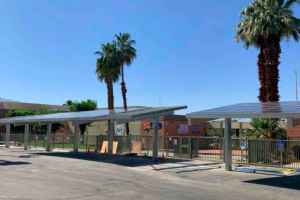 Palm Desert Charter Middle School went solar last spring! EcoMotion managed HVAC retrofits there, in addition to the implementation of 52 kW of photovoltaic power, with two solar arrays that frame the school’s entrance. Installed by PermaCity Skybridge, the system is made up of 144 Hyundai solar panels and uses Solar Edge inverters. Thanks to California Proposition 39 funding managed by EcoMotion, the School has cut its utility bill by 22% through energy efficiency and solar power.
EcoMotion has also completed the charter school’s Strategic Energy Management Plan (SEMP). The Plan focuses on PDCMS’s facility energy use and transportation energy use to determine the School’s carbon footprint. Additional energy efficiency and renewable energy opportunities are outlined by EcoMotion, means to power the School’s future, to shape its students, and to take climate action.
Renewable Energy Master Planning for Loyola Marymount
EcoMotion completed a Renewable Electricity Master Plan for Loyola Marymount University in June 2019. The planning process involved a broad look at both onsite and offsite generation options, with a focus on the existing solar systems there and the economics of potential solar system upgrades. An intriguing aspect of the plan involved fuel cells and microturbines – determining net carbon emissions in comparison to Los Angeles Department of Water and Power’s renewable portfolio timetable. Part of the analysis included renewable natural gas. At the conclusion of the project, EcoMotion prepared a planning report for LMU presenting four plausible scenarios for a) cutting costs, b) cutting carbon, and c) increasing resilience.
Smart Energy Management Garden Grove Unified School District - Garden Grove, California
Garden Grove Unified School District serves 45,000 students on 72 sites. It has a ~$12 million allocation of Prop 39 funds over five years, and hired EcoMotion to serve as its Prop 39 energy manager. Concurrently, the District is at the mid-point of a nearly half billion-dollar bond initiative which involves the retrofit of every one of its 69 school sites. The District’s attention has been necessarily on modernization and EcoMotion was hired to manage Prop 39 – from energy efficiency to renewables and storage — district-wide. EcoMotion has melded efficiency funds and initiatives with modernization, providing advanced efficiency through LED lighting and pool pump controls and other measures, and feathering in to the District’s construction schedule. Already we’ve enabled advanced levels of energy efficiency at six campuses, with that many again in the queue.
Along the way, EcoMotion and its Climate Smart Schools partnership with Climate Resolve has been instrumental in leveraging the Prop 39 program effect. We’ve won a $2 million grant for drought-tolerant planting, and to create bioswales on three high school campuses. We applied for and won a grant for zero net energy. Now we’re developing a zero net energy project at Santiago High School supported with a grant from Southern California Edison and Southern California Gas. It incorporates heightened levels of energy efficiency, solar, and storage, as well as student engagement. It was the ZNE project that propelled GGUSD’s pursuit of solar and storage. EcoMotion analyzed every school site for its solar financial viability and recommended solar at 20 of the largest campuses, plus the District office and its maintenance facilities.
Prop 39 Services Poway Unified School District - Poway, California
EcoMotion serves the Poway Unified School District with Prop 39 services, and we have for years thanks to our project lead at Barnhart Reese Construction. Working closely to PUSD’s own lighting, retro-commissioning, and HVAC engineers, EcoMotion has been instrumental in bridging between aspiration, on the part of the District, and fulfilling the stricture of the CEC’s guidelines. Thus far, a half dozen school sites have been retrocommissioned and largely relit – creating dramatic savings. In once instance, the installation of a “pony chiller” will allow for efficient operations during shoulder seasons when the central chilling plant’s full capacity is not required.
EcoMotion’s work for PUSD has extended beyond energy efficiency. We’ve evaluated solar proposals, in once case a 20-campus proposal situating panels on modular classrooms’ rooftops that was ultimately approved. EcoMotion also provided an independent review of a proposal to site energy storage systems on PUSD campuses. EcoMotion studied the proposal at hand, spoke with competing vendors, assessed the storage industry – specifically the interaction between solar and storage – and helped the District map a strategy for storage on 19 campuses backed with a performance guarantee. The systems will serve to reduce peak demand charges and are completely third-party financed, managed, and maintained.
Battery Back-Up and Solar and Prop 39 Santa Rita Union School District - Salinas, California
EcoMotion is currently working for the Santa Rita Union School District located in Salinas, California. Salinas, with a population of 150,000, is in the heart of agricultural Monterey County, known as “the Salad Bowl of the World.” Our work for the six-campus SRUSD involved two activities: First, we were asked to explore the use of battery storage systems for emergency back-up. The District has placed a high priority on six-hour storage to be able to keep students safely at school in the event of a power outage. The second task has been to examine the value of solar to the District. Our team analyzed bills for each campus and the District office (as well as adjacent Monterey County offices), conducted thorough site assessments, calculated emergency back-up requirements, and then evaluated energy and dollar savings opportunities for solar systems combined with rate switches. With Board approval, EcoMotion crafted and released a Request for Proposals for the District seeking emergency back-up (be it batteries or other forms of backup, including traditional generators) and an aggregate of 1 MW of solar. Bidders proposed one or both service options.
Prop 39 Services Fallbrook Union Elementary School District - Fallbrook, California
Known as the “Avocado Capital of the World,” Fallbrook is an unincorporated community of ~30,000 residents in rural Northern San Diego County. It’s due east of Camp Pendleton; two of the District’s schools are located on the Marine Corps base. FUESD has ten campuses, including a facilitated homeschool academy. Working on the Barnhart Reese Construction team, EcoMotion benchmarked each campus and then identified measures on one campus for its first, bundled, multi-year Energy Expenditure Plan for Live Oak Elementary School. Energy conservation measures (ECMs) identified include replacing 22 of the school’s existing inefficient heat pumps with higher efficiency units, the replacement of the heat exchanger flat plates to restore proper flow and heat transfer to the system. This will optimize the scheduled operation and control sequences of the cooling tower systems, balance the condenser water loops, balance the heat pump air intake, and commission existing system.
Prop 39 Services Savanna School District - Anaheim, California
EcoMotion is serving as the Prop 39 energy manager for Savanna School District, located in Anaheim, California. The six-campus district has recently modernized each of its campuses, one of which qualified for retroactive Prop 39 energy efficiency funding. EcoMotion’s work there involved an analysis of pre-modernization baseline conditions, retrofit details and the resulting energy savings, thus the retrofit’s costs and benefits. EcoMotion worked closely with the project architect and project manager. Lighting, HVAC, and other retrofit measures qualified for funding and thus were included in the Prop 39 funding request, a multi-year Energy Expenditure Plan.
Prop 39 Services Cypress School District - Cypress, California
EcoMotion is serving as Prop 39 Energy Manager for Cypress School District. As with Savanna School District, Cypress features recently modernized campuses, one of which qualified for retroactive energy efficiency funding. Works there involved an analysis of pre-modernization baseline conditions, retrofit activity, its costs and benefits. EcoMotion worked closely with the project architect and project manager Lynne Pentecost of Schoolhaus Advisors. The Cypress School District strategy is to develop a multi-year Energy Expenditure Plan that includes both retroactive funding and new measures to save energy and dollars for the District.
Prop 39 and Solar Santa Rosa Academy - Menifee, California
Santa Rosa Academy is a charter school located in Menifee, California. The K-12 school features three academic tracks allowing for on-campus study, home schooling, and a middle-ground program. EcoMotion’s role on campus has been to determine the best use of the school’s Prop 39 allocation, made a bit more complex given the fact that the brand-new campus was built to California’s rigorous Title 24 building standards.
After a thorough investigation of the campus, and working closely with its builder, EcoMotion and the school decided to focus on a two-pronged approach. First was an analysis of solar opportunities on campus. EcoMotion developed various scenarios including a 100% solar option. Ultimately, the school elected to pursue an 85 kW solar system to be installed in the roof of its brand new gym. EcoMotion coordinated this solicitation with the school’s architect and builder, crafting an RFP, managing job walk and bidders’ questions, and making a recommendation to the school on a select contractor. A second use of its allocation will be used to fund an energy management system (EMS) to control the school’s 64 rooftop HVAC units. The new system will allow for controls and monitoring.