
In This Issue
- Flanigan’s Eco-Logic: Let’s Keep an Eye on the Ball
- Decarbonizing New York City
- Toyota’s Big EV Shift
- EV Updates: Blade Batteries, The Ford Lightning, 1 Million Sold in California
- The Drive-in Diner Comeback?
- Pairing Crops with Solar
- Blue and Green, Hydrogen and Ammonia
- The National Electric Highway Coalition
- Chinese Wind Production
- The NetPositive Podcast Updates

Flanigan’s Eco-Logic: Let’s Keep an Eye on the Ball
Just three days after an unprecedented stampede of tornadoes ripped through Kentucky and its neighboring states on December 10, California policymakers were in the process of rolling back a hugely successful solar policy called Net Energy Metering. Climate change be damned.
Record and devastating storms worldwide are the result of human-induced climate change. It is upon us… so we’re scrambling for solutions… means to cut CO2 from getting into the atmosphere. A primary means of doing that in the electricity sector — long known for its dirty coal-burning power plants — has been to promote renewable energy. We’re cleaning the grid in leaps and bounds.
Net energy metering has helped homeowners, schools, and businesses develop a network of distributed, renewable energy resources. This is unquestionably good for our climate. Like the federal tax credit (ITC), Net Energy Metering (NEM) helps consumers get compensated for their investments in solar. The deal is simple: when a solar system over generates, it gets credit for those times that a home or business needs to draw from the grid, for instance at night. This flexibility has ushered in a strong solar movement in our communities.
But instead of recognizing the need to maintain growth in this industry, much less to accelerate climate mitigation measures, at the instigation of California’s investor-owned utilities, the California Public Utilities Commission took a big, bad swing at distributed solar. The range of “NEM reforms” considered by the CPUC included monthly fees, shorter grandfathering terms for favorable tariffs, lower export values, and even a kWh charge for self-generation! See EcoNet News Volume 23, Issue #1 for a discussion of the options.
After months of deliberations and lobbying on all sides, the CPUC’s proposed decision, strips local solar of important incentives and instead imposes draconian fees on those who invest in solar to care for the planet.
Need we not keep our eye on the ball? Tornadic activity, fires, floods, droughts, wind storms, hurricanes… all increasing in frequency and ferocity. I salute all those Americans who have invested in solar, and who have taken big actions on their homefronts to address the climate reality head-on. Now others that do so will be taxed with monthly fees and less credit values.
Sure, there are subsidies and equity issues. We need solar (and now storage) programs for all. We need rooftop solar. We need community solar. We need utility-scale solar. To combat climate change, and fast, we need it all. Look at the progress. A solar industry is now rooted in our communities. Prices are coming down, and now storage can be paired with solar for resiliency. You can’t get that with utility-scale solar in the desert. And we have local jobs helping to beat back climate havoc.
Yes, it is more expensive to build on rooftops than in the desert… but the benefits are huge and now are being stripped away in favor of a narrow view of cost effectiveness. Imagine the costs of climate change. Huge and born by all ratepayers. Inaction on climate protection will cost us all more than any form of NEM. This is the big picture. This is keeping our eye on the ball. And now, our voices must be strong.
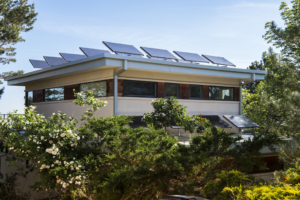
Beneficial rooftop solar is in peril. Not a good way to end the year. This is not a present for the future, but a big step backwards. Should a proposed decision become final, the household solar industry in California will be severely impacted. Less solar. Right when we clearly need it most. Can we stand policies that retard progress to a clean energy future? No.
Sure, if you only made state policy through a lens of financial cost effectiveness for our utilities – one of the most polluting sectors in our society – we’ll suffer from severe impacts of climate. But we well know that utilities must be regulated to achieve certain objectives, some economic of source, others environmental, and others societal. It isn’t just about the money… we’re on a mission to green our power system and to save the world.
The general manager of our local utility has been tracking the CPUC action. He intends to follow suit on NEM. So will many other utility leaders. California’s illogic may be emulated by other states. Sure, no one wants to pay too much for distributed solar… but we all want/need these resources to augment utility-scale renewables. Let’s pair solar with storage for maximum system benefit and for resiliency at the household level. But replicating California’s solar stab is the kind of climate leverage we simply cannot tolerate.
Quote of the Week
“With the formation of the National Electric Highway Coalition, we are committed to investing in and providing the charging infrastructure necessary to facilitate electric vehicle growth and to helping alleviate any remaining customer range anxiety…”
Tom Kuhn, President, Edison Electric Institute
Decarbonizing New York City
 Good old Ithaca, New York. Population 30,000. I think Cornell. It’s a “cold corner” of New York, tough winters, summers that are too short. There’s lots of heating oil and natural gas burned in boilers and furnaces to warm the City’s 6,000 homes and buildings.
And then a policy. Ithaca is the first U.S. city committed to 100% decarbonization of its buildings. Someone called it an “urban climate change milestone.” In the first phase of a novel 100% carbon-free city climate policy, Ithaca plans to cut 40% of its entire footprint, 160,000 metric tonnes of CO2e by 2030 through its Efficiency Retrofit and Thermal Load Electrification Program. The first phase will address 1,600 buildings. Funding will be largely private sector, with grants, incentives, and rebates reaped, and a fund that the City will develop for philanthropic donations to lower the program cost for low-income households. BlocPower has been contracted to lead the effort.
In the Big Apple, buildings are responsible for 70% of total GHG emissions. New York City’s Local Law 97 is a “daunting decarbonization mandate.” Imagine decarbonizing New York’s famous skyline. Local Law 97 is doing just that. It’s one of 10 bills in the sweeping Climate Mobilization Act passed and signed into law in 2019. It requires New York City’s 50,000 largest buildings, which are responsible for 60% of both the City’s floor area and emissions, to reduce their carbon emissions by 40% by 2030, and by 80% by 2050.
The largest 25,000 buildings must meet reduction targets by 2024. Owners of non-compliant buildings face fines based on $268/ton starting in 2024. A large building could face fines of up to $5 million annually. But the City wants the emissions reductions, not the fines. PACE financing is available. New York is exploring a cap and trade system for decarbonizing buildings. One that works. Tokyo enacted one in 2010 but out of an eligible building pool of 1,000, only 30 trades have been made.
New York City has a carbon neutrality goal of 2050. City, ConEd, and National Grid staff worked with ICF, the Energy Futures Initiatives, and Drexel University to conduct a comprehensive analysis of the City’s energy supplies and demand through 2050, running different pricing scenarios. While New York is already on a clean energy path thanks to existing City and State policies, the study pointed out additional steps needed to reach the goal:
- Energy efficiency in more than 900,000 buildings
- Electrification of heating and hot water in 642,000 buildings
- 375,000 EVs by 2030 and more than 1 million in 2050
- 800,000 Level 2 EV chargers and 60,000 fast chargers for trucks
- Dramatic switch to renewable power generation, plus storage
- Transition to low-carbon fuels such as RNG and hydrogen
The study outlined three plausible pathways to reach the goal: 1) the Electrification Path, 2) a Low Carbon Fuels Path, and 3) a Diversified approach taking pieces from each of the first two. The cost, somewhere in the range of $1.5 – 2 trillion dollars between 2020 and 2050.
Toyota’s Big EV Shift
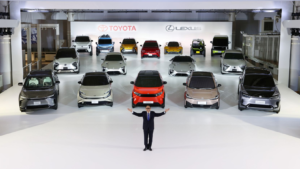 Toyota has heretofore been criticized for its position on electric vehicles. It’s been viewed as an EV laggard. For years it bet on hydrogen fuel cells and hybrid vehicles. Toyota lobbied against EVs, and worse, it has been accused of spreading misinformation to tamp down EV enthusiasm and sales.
But now, Toyota appears to have turned a corner. It shocked the EV world with the announcement that it will spend $70 billion to electrify its lineup of vehicles. Currently, Toyota’s fleet is heavy on hybrids and plug-in hybrids. Now Toyota is planning to launch 30 new electric models this decade. The automaker has revealed 16 concept EVs for its Toyota and Lexus brands. Toyota’s goal is to sell 3.5 million EVs globally by 2030.
“We will not only add battery EV options to our existing vehicle models but will also offer a full lineup of reasonably priced mass-production models, such as the electric bZ series, to meet the needs of all kinds of customers,” said Toyota President Akio Toyoda. Toyota recently released its bZ4X, a crossover and the first EV from its Beyond Zero sub-brand. Also in the wings is the new electric pickup, an electric version of the popular Tacoma pickup.
EV Updates: Blade Batteries, the Ford Lightning, 1 Million Sold in California
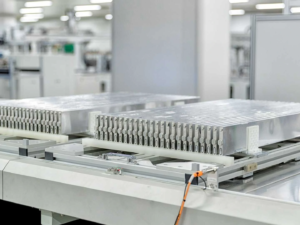 BYD’s Blade Battery has attracted lots of attention. The cells are made with lithium iron phosphate chemistry (LFP) and are less costly and safer. The BYD Blade Battery pack runs cool with fireproof chemistry and configuration. It has an intrinsically safer cathode. LFP and NMC are two different sub-chemistries of lithium-ion batteries. While LFP uses the lithium iron phosphate as cathode material, NMC (commonly used in EVs) uses lithium, manganese, and cobalt.
BYD’s LFP batteries are now being shifted to electric cars after successful use in buses. Tesla is already using LFP batteries for EVs built in its Shanghai factory. Now Tesla is considering these batteries for its EV project in China to develop a $25,000 car. Toyota is also partnering with BYD for the batteries to build a new affordable car.
Ford reports nearly 200,000 reservations for its F-150 Lightning pickup truck… three years of backlog after doubling production! The all-electric version of its best selling pickup is indeed popular. Since announcing the Lightning, Ford has taken reservations with a $100 refundable deposit for trucks that will begin to arrive mid-2022. Ford received 20,000 reservations on the day it announced the truck… which ramped up to 44,000 in 48 hours. The automaker notes that 75% of the reservation holders are new to the Ford brand; 25% were replacing gasoline power F-150 pickups. Of the reservation holders, 40% are already EV owners, in fact, 11% are Tesla owners.
In related news, a California milestone! In November we passed the million EV mark. That’s about 1/12th of all EVs worldwide. There are now three dozen companies making EVs in California; EVs are now the State’s largest export.
The Drive-in Diner Comeback?

Image Courtesy of Electrify America
The return of the drive-in? A time to charge your EV while you enjoy fast food and root beer potentially delivered by “carhops” on roller skates? The EV may be bringing this quaint bit of automotive America back again says a report from Evannex.
Electrify America plans to offer a drive-in experience at its new charging stations at the Westfield Valley Fair shopping center in Santa Clara, California. EV drivers will be able to order meals from mall restaurants that will be delivered to their cars as they charge. The location will feature 14 ultrafast chargers charging at 150 – 350 kW. Solar canopies above the chargers will protect customers from the elements and charge batteries that will be discharged to cut peak demand.
Elon Musk also promises the drive-ins for EV drivers, as well as big screens. He proposed a 1950s-inspired diner at a new supercharger station in the city of Santa Monica. There, Tesla plans to sell its own food under its own brand. (It once sold its own brand of tequila.) The company has registered its “T” logo with the U.S. Patent and Trademark Office under “restaurant services, pop-up restaurant services, self-service restaurants, and takeout restaurant categories,” an indication of corporate direction. The Santa Monica site will have a diner, 62 chargers, large spaces for Cybertrucks, and a drive-in movie theater.
Pairing Crops with Solar
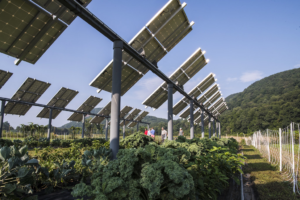 A new study from the University of Illinois presents findings on pairing agriculture with solar. It finds a synergy between two forms of useful production that have been perceived to be competitive for precious land. A $10 million grant-funded the “agrivoltaics” study which focused on how to “sustainably co-locate ag and photovoltaic systems.” This has a fancy name: SCAPES which stands for Sustainable Colocating Agricultural and Photovoltaics Electricity Systems. Row crops, foraging crops (for livestock) and speciality crops will be studied across three biophysically diverse regions of the country: Illinois, Colorado, and Arizona. Ideally, through colocation, the combined benefit is greater than the benefit of a single use.
An example comes from research by the Fraunhofer Institute in Freiburg, Germany. It found that covering a wheat field with raised solar panels resulted in wheat production that was 80% of what it would have been if there were no solar. And solar took a 20% hit too… providing only 80% of what it would have if there were no farming involved. But the combined effect is remarkable… dramatically increasing the net revenue from the same piece of land.
Blue and Green, Hydrogen and Ammonia
The tanker shipment of blue ammonia to Japan caught my attention. Aramco and partners are boasting the world’s first – and now third – blue ammonia shipment. Aramco and the Institute of Energy Economics successfully demonstrated the production and shipment of blue ammonia – initially 40 tons – from Saudi Arabia to Japan with support from the Japanese Ministry of Economy, Trade, and Industry. High-grade blue ammonia was dispatched to Japan for zero-carbon power generation.
Why not just ship hydrogen? Turning hydrogen into ammonia allows it to be stored and shipped more easily. When burned in Japan, it will be totally carbon-free because the ammonia has already been stripped of its carbon. Aramco calls it a “new route to a sustainable future.” Not sure about that. What’s up with ammonia? A fuel? Yes. It is a fuel and fertilizer. Some say that blue ammonia may be a key to global energy transportation since it emits only water vapor when it is burned.
Let’s back up a bit: Ammonia is an inorganic compound produced through a chemical reaction between hydrogen and nitrogen at high pressure and temperatures. The process is energy-intensive. Ammonia production accounts for ~2% of energy consumption and ~3% of carbon emissions worldwide. The process also uses up to 5% of global natural gas production; the annual ammonia market value is reported at $72.8 billion.
Saudi Aramco’s blue ammonia comes from natural gas feedstocks. It is not a renewable fuel. Methane (CH4) is stripped of its hydrogen, releasing carbon dioxide. The hydrogen is then combined with nitrogen to create blue ammonia (NH3). What makes it blue is that the carbon dioxide stripped away as a byproduct of ammonia production is captured and stored underground. Gray ammonia is made from natural gas, and the resulting CO2 is not captured. So what’s green ammonia?
Green ammonia, instead of being derived from fossil fuels, is made of green hydrogen. It’s better than blue, which is better than gray. Green ammonia is made from water that has been electrolyzed using renewable energy to form hydrogen. Green ammonia is made of green hydrogen and nitrogen.
A recent Smithsonian Magazine article is titled “Blue Hydrogen May Not be a Very Green Energy Source After All.” Blue hydrogen had previously been touted as a better alternative because the production emissions are captured and stored deep underground. But new research from Cornell and Stanford suggests that its use could be worse than burning coal. It takes a lot of energy to make the blue hydrogen. And when considering the un-captured methane, and the large fugitive emissions inherent with natural gas, the use of blue ammonia is more energy-intensive than burning fossil fuels directly. “Blue hydrogen is hardly emissions-free,” noted the authors of their study published in Energy Science and Engineering. “The best hydrogen is green hydrogen derived from electrolysis.”
The National Electric Highway Coalition
 The Edison Electric Institute (EEI) has announced the formation of the National Electric Highway Coalition. It’s made up of 51 investor-owned utilities, one electric cooperative, and the Tennessee Valley Authority. Its goal is to provide electric vehicle fast-charging ports along major U.S. travel corridors by the end of 2023. The current Coalition members serve nearly 120 million electricity customers across 47 states and the District of Columbia.
EEI estimates that the United States will need more than 100,000 fast-charging ports to support the 22 million EVs projected to be on American roads in 2030. That represents more than a ten-fold increase over today’s level.
A number of strategies have been discussed for the Coalition. Its member companies will concentrate on extending high voltage connections to existing or new charging locations along highway routes, such as convenience stores, gas stations, and auto dealers. It will find ways of working with commercial entities, adding fast-EV charging capabilities. The Coalition also intends to link with the federal government’s infrastructure plan that includes $7.5 billion for charging networks.
Chinese Wind Production
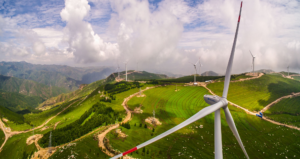 Reminded, I am, this time of year about consumerism… and how much stuff we buy. It’s oft swathed in packaging. Much of it comes from China, “the world’s factory” and the world’s leading GHG polluter. Producing stuff we buy.
The good news is that China is the world’s leader in clean energy growth. Its cumulative installed onshore and offshore wind capacity stands at 302.2 GW according to Windpower Intelligence. Of this, 10 – 12 GW are offshore. China built half of the world’s wind capacity in 2020. The country is expected to install 1,200 GW of wind and solar capacity by 2026, four years ahead of its prior plan. China has huge wind potential, estimated at 2,300 GW onshore, and 200 GW offshore.
The largest wind turbine manufacturer in China is Goldwind, in the Xinjiang province. In 2019 it joined a partnership to develop a wind-to-hydrogen project in northeast China. The project goal is to put currently unused wind generation potential to good use and turn stranded wind power into a cheap energy source for hydrogen production. In 2020, Goldwind and GE took the top spots for wind turbine manufacturing, topping Danish Vestas.
According to Bloomberg NEF, 2020 was a banner year for wind in China. It reported that “developers piled into the market” before a looming cut-off for new wind power subsidies from the government. China is slated to end subsidies for onshore wind power in 2021. Its National Development and Reform Commission said tariffs paid to onshore wind projects will be cut as low as 0.29 yuan ($0.042/kWh).
The NetPositive Podcast Updates
 Recently Released:
- This issue of EcoNet News, Volume 23, Issue #12 is also available in podcast format
- The NetPositive Podcast: A Conversation with Gary Gero, Chief Sustainability Officer, Los Angeles County
- The NetPositive Podcast: A Conversation with Dan Mabe, Founder, President, and CEO of the American Green Zone Alliance
Check out and subscribe to The NetPositive Podcast with Ted Flanigan on Spotify, Apple, and Google. Episodes include Convos (Conservations and Crash Courses), the News (EcoNet News), and Uni (the EcoMotion University).