
July 2, 2015 – Volume 17, Issue 1: The Campus Special
In This Issue
Flanigan’s Eco-Logic
“The Universe” of U.S. Education
New England Campus Services
Thayer Academy
Moses Brown School
Saint Joseph’s College of Maine
St. Mark’s School
EcoMotion is Hiring!
The AASHE Special
Millbrook 100% Solar-Powered
Garden Grove Unified School District: A Prop 39 Success Story

Flanigan’s Eco-Logic: Circadian Correct Lighting on Campus?
EcoMotion has worked in the education sector for years, lecturing and consulting, bringing programs to campuses, training professionals for new paradigms. We focus in three areas: operational efficiency, planning and policy, and student engagement.
In terms of operations, we tighten campuses and reduce footprints through energy efficiency and solar. It’s a pleasure to work with facilities personnel and accelerate project implementation. Now our team is also focused on cutting water use. Student engagement is a forte, with a team of professionals in New England that are firing up students and administrators. We’ve recently developed a three-part series for entrepreneurs on opportunities in solar, storage, and microgrids.
As this edition features, we are delivering multi-faceted smart energy management for a large Southern California school district. It has 72 campuses and enormous opportunities for comprehensive energy efficiency retrofits, student programs, and potentially solar and storage. We’ve already secured a water-saving grant there. We also serve as energy managers for two other Southern California school districts, one with 40 sites and the other with eight sites.
This issue speaks to some of our work in New England, in New York, and in California. The work is rewarding and meaningful. We’re making a difference on campus, saving energy, money and the environment while inspiring students to be change agents. But my great friend Michael Totten was a bit disappointed in me: “You’re not using circadian-correct lighting on campuses?” Frankly, no. I’d never heard of it.
On the West Coast, EcoMotion is in the process of relighting four high schools and five elementary schools with many more to come. In each case, we’re replacing all lights with LEDs. That’s all classrooms, hallways, gyms, multipurpose rooms, and parking lots. But to the best of my knowledge, the lighting systems that we are putting in are not “circadian correct.” So I dig in. I’m still looking for marginal costs.
The rise of solid-state lighting, the rise of light emitting diodes or LEDs, enables “tunable” lighting systems. Tuning can take at least two forms: adjusting the intensity of the light and its spectral definition, i.e. its color. Medical research is finding that tunable lighting that honors circadian rhythms could enhance lighting quality, energy savings, and human health. While the goal of effective lighting has been to optimize on visual comfort, task performance, and energy savings, now we add health.
Before there were “artificial light sources,” human’s experienced a progression of different wavelengths of light during the day, beginning with short wavelength blues (460 nanometer wavelengths) in the morning, then as the sun arcs high, short wavelengths are replaced by longer wavelength light. Red-rich lighting then takes over, think sunsets and restaurant lighting.
Circadian rhythms are the physical, mental, and behavioral changes that follow a 24-hour cycle. Their primary stimulant is light and darkness. Circadian rhythms are found in most living things, animals, plants, and tiny microbes. Human eyes have photoreceptors that regulate circadian rhythms by triggering the production of neurochemicals that affect everything from sleep to moods, to the health of our immune systems.
The more I study, the more excited I get about the link between health and wellbeing and lighting. Sure, everyone wants an office with a window. It feels good. Now researchers are beginning to understand why. We want to be basked in sunlight, and sunsets. Now there is an opportunity to combine controls with drivers, and tunable LED luminaries to mimic daily patterns of natural lighting.
Consider this from Philips and its HealWell lighting systems for health care: “By mimicking natural daylight patterns in hospitals, where patients are indoors all day, artificial illumination can support a healthy sleep-wake cycle. HealWell has been designed specifically to achieve this by automatically changing the brightness and hue of the light throughout the day, reflecting the conditions outside.”
Perhaps not too distant in the future, lighting systems will be addressable and tunable. The marginal costs of tunable lighting systems will shrink and more and more of us will have “circadian-optimized light sources.” Students may be more alert; comprehension and test scores may rise. Workers may not need a second cup of coffee. Sleep patterns can be reinforced, and our moods may be better!
Quote of the Week
“We are thrilled to expand our team and impact on campuses with the addition of a new Sustainability Coordinator at EcoMotion.”
The Universe” of U.S. Education
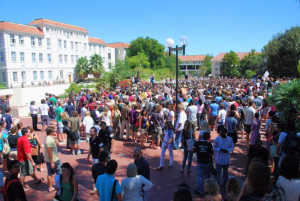
There are 136,423 primary and secondary schools and colleges of higher education in America. This according to the National Center for Education Statistics based on 2012 data. Of the total, 98,328 are public schools, 30,861 are private schools, and 7,234 are in higher education.
In 2012 there were 21 million Americans enrolled in higher education, 5.7% of the U.S. population. This includes 2,529 “post secondary Title IV institutions” and 4,706 degree-granting institutions. Title IV institutions authorized by the Higher Education Act of 1965 have signed letters with the Secretary of Education allowing them to participate in federal student assistance programs. Of the 7,234 institutions constituting higher education in America, 4,706 are degree-granting institutions. Of these, 2,968 are four-year institutions; 1,738 are two-year.
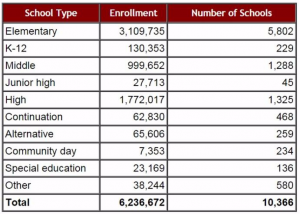
2013-14 Enrollment in California Public Schools
In terms of elementary and secondary school systems, there are 14,176 public school systems in America. There are 132,183 school sites of which 98,817 are public, 33,320 are private, 6,187 are charters, and 7,110 are Catholic schools. According to CalEdFacts, California has 1,028 public school districts and 1,125 charter schools.
During most of the last century, the trend to consolidate small schools brought declines in the total number of public schools in the United States. In 1929, there were 248,000 public schools, compared with 98,000 in 2011. Today’s roster of schools in made of 66,689 elementary; 24,357 secondary; 6,311 combined; and 971 other. Of California’s public school districts, 341 are unified, 531 serve elementary only, 77 are high school only, and 79 fall in the “other” classification.
Total primary and secondary enrollment in 2011 was 54,876,000 students of which 49,484,181, or 90.2%, attended public schools. In the fall of 2014, 49.2 million students attended public schools, taught by 3.1 million teachers, resulting in a pupil to teacher ratio of 16:1, same as the ratio in 2000. The average private school ratio was 12.5:1. In California’s public schools, that ratio was 21:1 in the 2013/2014 school year.
EcoMotion New England Campus Services
For the past five years, EcoMotion has maintained a New England Campus Services division at our offices at the Cambridge Innovation Center in Kendall Square. If you haven’t been to the CIC, give us a call and stop by when you’re in town. It is an inspiring co-working space that buoys our team with energy and innovation.
EcoMotion’s Campus Services team works with schools and colleges, we’ve served as a convener, we’ve partnered with other like-minded groups, promoted regional efforts and collaborations, green revolving funds, and more recently ESAs, energy savings agreements. Our core business in New England is “drop-shipping” our experts onto campuses for one or two days a week, supported by our technical teams. Their on-site services are both the catalyst and the glue, engaging all stakeholders to advance sustainability.
 Bryant University is our New England flagship. There, sustainability is treated as smart business. Our work is directed by the Vice President for Business Affairs who sees a number of benefits, and lives by the metrics. At Bryant, our team formed and continues to facilitate a fully engaged Sustainability Committee. We have published two editions of the Bryant University Sustainability Plan and we developed a rigorous Sustainability Tracking System to ensure that specific parties are held accountable for its implementation. The burgeoning Student Ambassadors program is in its third year. We were instrumental in integrating sustainability into the new, five-year dining services contract, and we recently held information sessions at new student orientation.
EcoMotion has recently been retained by three independent schools and one college in New England. We look forward to rolling up our sleeves to work hard serving these new accounts and building key relationships with students, faculty, staff, alumni and others to generate results.
Thayer Academy, Braintree, MA
 Located in the suburbs of Boston, Thayer Academy is a private, co-ed school with a colorful history. It was founded in 1871 by General Sylvanus Thayer, considered the father of West Point where both graduated and served as its superintendent, and benefactor of the Thayer School of Engineering at Dartmouth College (a $40,000 donation in 1867). The Thayer Academy was formed at the bequest of his will, now a 34-acre campus with 690 middle and high school students.
Thayer has taken a number of exemplary steps with environmental stewardship. Its campus features LED lighting, recycling, an Environmental House, gardens, and more. EcoMotion has been retained to convene and facilitate a Sustainability Committee and implement practical projects on campus. This past month, EcoMotion has been driving an interesting recycling project, tagging surplus office and classroom items and finding ways to donate and repurpose them.
Moses Brown School, Providence, RI
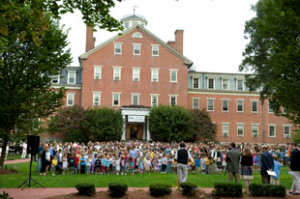
Moses Brown students gather on campus
Founded in 1784, Moses Brown is an independent, college preparatory school located in Providence, Rhode Island. Moses Brown enrolls 765 students, nursery through grade 12. The School’s commitment to environmental stewardship is strong. Its Sustainability Committee has been working for years to educate the community and to reduce waste and the School’s carbon footprint. Moses Brown has established partnerships with Newport Biodiesel, New England’s first sustainable producer of biodiesel fuel, and the Compost Plant, a local start-up with plans to collect and compost food waste from Providence-based restaurants and schools.
EcoMotion is working at Moses Brown to conduct a Campus Sustainability Assessment of its sustainability program, called “Sustainable MB.” EcoMotion will identify and document sustainability accomplishments to date while outlining and prioritizing opportunity areas. We’ll also compare efforts and achievements with peer schools, and lay out short-term and long-term recommendations for advancing sustainability at Moses Brown.
Saint Joseph’s College of Maine
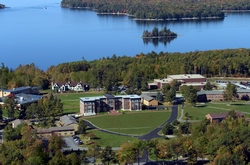
Saint Joseph’s College campus
Saint Joseph’s College is located in Standish, Maine, situated on 430 acres along the shoreline of Sebago Lake. It is a catholic, liberal arts college. Through its online programs, the college serves students in all 50 states and nine countries.
Saint Joseph’s signed ACUPCC and joined 685 campuses committed to developing comprehensive plans to achieve climate neutrality and to conduct greenhouse gas inventories. EcoMotion will support carbon neutrality on campus. In addition, we will conduct a STARS Silver Gap Analysis, generate content for a Sustainability Website, support their Green Revolving Fund, and advise on the College’s Campus Ecology Partnership.
St. Mark’s School, Southborough, MA
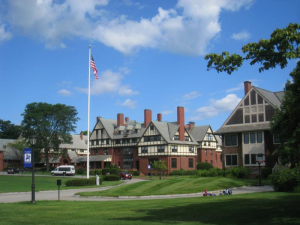
St. Mark’s School campus
Situated on 250 acres and founded in 1865, St. Mark’s School “educates young people for lives of leadership and service.” Three hundred and fifty students are part of the close-knit St. Mark’s community. The academics are rigorous. The Center for Innovation in Teaching and Learning, Global Citizenship Initiative, and academic programs for Science, Technology, Engineering and Mathematics (STEM) education exemplify the School’s commitment to academic excellence. The campus is breathtaking.
EcoMotion has been hired by St. Mark’s to advance and accelerate its sustainability program with a focus on developing a Student Sustainability Leaders Program, forming and managing a campus-wide Sustainability Committee, and engaging stakeholders across campus to create a Sustainability Plan that will serve as a campus road map for sustainability.
EcoMotion is Hiring in New England
UnConference Volunteers on Earth Day
EcoMotion is hiring a Campus Sustainability Coordinator in New England. The Coordinator will be headquartered at the Cambridge Innovation Center and will be in the field serving EcoMotion accounts in Massachusetts, Rhode Island, New York, and Maine. The ideal candidate will be highly motivated and have a strong background in campus sustainability and project management.
To be considered for this position the candidate must have excellent verbal and written communication, must be highly organized, a safe driver, and have a flexible attitude with a penchant for collaborative work. To apply, please send resume and cover letter stating your interest and pertinent experiences and skill sets via email to Sierra Flanigan, Director of Campus Sustainability (SFlanigan@EcoMotion.us).
EcoMotion is seeking an intern for its LA office. Applicant must be passionate about greening the planet, artistic, be willing to work hard, and preferably skilled in Word Press and the Microsoft Office suite. Compensation and training will be provided.
The AASHE Special
 EcoMotion salutes the Association for the Advancement of Sustainability in Higher Education (AASHE) and its leadership. We are members of AASHE for its multiple benefits. We’ve supported AASHE’s Solar Database, a rich repository of 563 installations on 327 campuses in 46 states and provinces. In the past five years, solar has grown from an aggregate capacity of less than 20 MW to over 200 MW of installed capacity today on campus. Today, AASHE reports 215,268 kW of installed capacity in its online database.
For several years, our solar team served as AASHE’s Specialist Solar Advisor. In that capacity we offered each of AASHE’s 862 campus members no-cost, solar consultations. We’ve supported each of the following campuses with precise solar expertise:
University of Southern California
Morehead State University, Kentucky
University of Richmond, Virginia
University of South Carolina, South Carolina
University of Arkansas, Arkansas
University of Hawaii West Oahu, Hawaii
Bowie State University, Maryland
Beloit College, Wisconsin
Luther College, Iowa
Bradley University, Illinois
Pittsburg State University, Kansas
New Mexico State University Grants Campus, New Mexico
Elon University, North Carolina
Florida State University, Florida
Elizabeth City State University, North Carolina
Villanova University, Pennsylvania
State University of New York Brockport, New York
Eastern Kentucky University, Kentucky
George Mason University, Virginia
University of California at Los Angeles, California
California State University at Long Beach, California
Long Island University, CW Post, New York
Dozens of universities and colleges across the country tap the EcoMotion solar advisory resource. EcoMotion now also collaborates with members of the New Jersey Higher Education Association for Policy and Sustainability (NJHEPS).
Sierra Flanigan, Director of Campus Sustainability, serves on AASHE’s Advisory Council and in that capacity has begun collaborating with the International Society of Sustainability Professionals to support the generation of a certification for sustainability professionals. For more information and/or to participate in a beta test, please contact Sierra at (949) 303-8433 and/or visit: http://www.sustainabilityprofessionals.org/sustainability-professional-certification.
Millbrook Now 100% Solar-Powered
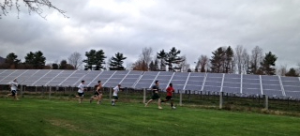
Students run around the ground-mounted solar
After 1,015 days and nearly three years of work as the School’s solar consultant, the 1.73 MW Millbrook School solar system has been cleared by Central Hudson Electric and Gas to operate for 20 years.
EcoMotion was initially hired to support a solar project, but soon our scope exploded. Millbrook and its Board had made a commitment to go carbon neutral by 2020. The Board wanted to consider solar in a broader context, so we became the carbon mitigation strategist. One Board member wanted us to evaluate the cost of bringing gas on campus. The price for the seven-mile line was $5.174 million.
Back on track, and to the first step of any solar project: Our audit of all 43 buildings on campus documented 107 efficiency opportunities with insulation, new windows and doors, lighting, and for geothermal heating systems to replace aging oil-fired boilers. That led to solar system sizing: Efficiency would lower consumption. Concurrently, the School was adding a new dorm, now a new dining hall and maintenance facility. And we’d need more capacity for additional geothermal pumping.
After considerable project siting and planning, and with the Board’s support, EcoMotion developed a Request for Proposals for the solar system. We helped secure a $1.25 million grant from the New York State Energy and Research Development Authority. Three bidders were able to undercut the low price the School was paying for power. The winning bid was a PPA price of 7.5 cents for 20 years with a 0% escalator. We’d also insisted that Millbrook retain the Renewable Energy Credits (RECs) associated with the solar system output. RECs are traditionally held and monetized by PPA investors.
After interconnection challenges, the system is up and running. There have been no neighbor complaints. Instead, the School community is proud and has a new slogan, “Power Full!” Millbrook School has cut its footprint by 35%, will lower its annual utility bill by $40,000, and it will save at least a million dollars over 20 years.
EcoMotion tracked New York State incentives, panel prices, and depreciation schedules to recommend the right time to pull the trigger. We worked closely with School officials and the Board to frame up a viable project. Ultimately, we found a solution to finance the system with no money down. Now we move on to Phase 2 of the carbon neutrality plan.
Garden Grove Unified School District: A Prop 39 Success Story

EcoMotion and GGUSD staff submit expenditure plan
There’s something special happening at Garden Grove Unified School District (GGUSD) thanks to Prop 39, the California Clean Energy Jobs Act of 2012. At a large school district with 45,000 students on 72 campuses, several kinds of benefit are in play, from energy saving to shaping young students’ careers and shifting the community toward a sustainable future. Perhaps the highest and best value of Prop 39 is being realized.
The story begins with a dedicated and able group. Director of Facilities Margie Brown is at the helm, supported by her Energy Manager Kevin Heerschap. Their boss Rick Nakano plays an important guiding role. EcoMotion provides technical services for Climate Smart Schools (CSS), taking direction on priorities and timing and melding GGUSD’s best interests with the Prop 39 statutes.
In addition to energy efficiency retrofits, GGUSD students are getting engaged. Thanks to a dedicated environmental sciences teacher with contagious energy, Teri Osborne, now other teachers are stepping forward and joining the initiative. There’s a new, green energy budding on campus.
Climate Smart Schools was formed to serve as an “honest broker” in the Prop 39 space. We’ve pledged to districts to listen carefully to their needs and priorities, and to help them get maximum value from their allocations of Prop 39 funds. In fact, we leverage Prop 39 funds.The process at GGUSD began with gathering all the District’s electric, gas and water bills. Then we created a dashboard to organize and track these utilities on an ongoing basis. The dashboard allows for sorting by energy and water use, relative intensity, then per square foot, and per student.
Graphics made clear the relative energy and water intensities of the school sites. It was not only revealing, but helped sleuth a broken water main at a closed school. A presentation to the District resulted in a guiding discussion and ultimately the GGUSD Prop 39 strategy. It was codified in a Five Year Smart Energy Management Plan developed by Climate Smart Schools and approved by the School Board.
A Prop 39 requirement is that all projects are rooted in engineering analysis. Given gross time-related delays with “no-cost” California Conservation Corps, ASHRAE “Level 1.4” audits, Climate Smart Schools fielded its own assessment team. Our technical team documented lighting, HVAC, and other technologies on each of the campuses in detail. We developed a feasibility study for each campus, presenting the current status, upgrades, cost, benefits and the “SIR” threshold for each and aggregated measures.
Thanks to changes to the guidelines, the economics of our efficiency works were allowed to meld with the District’s half-billion dollar modernization work. The result: Every fixture on campus will now be highly efficient and long-lasting light emitting diodes. We’re bringing the highest efficiency to the District, complete LED retrofits in classrooms, parking lots, gyms, and theaters. Pool savings are also part of the plan, from heaters, to pumps, variable frequency drive controls, and covers.
The assessments, coupled with cost estimates, were used in GGUSD’s first Prop 39 submittal. It was a double submittal involving comprehensive retrofits of two high schools and three elementary schools with a combined Savings to Investment Ratio of 1.17. The submittal was expeditiously approved in December 2014 and was the largest in Orange County at the time.
Climate Smart Schools is very much looking out for its client districts. We’ve evaluated rates, direct access contracts, solar Power Purchase Agreements, PEAs, ESAs, efficiency opportunities of all kinds. And we’ve also got into water, California’s #1 resource issue.
DROPS was being promoted by the California State Water Resources Control Board. The grant program features storm water retention and drought-tolerant landscaping. Climate Smart Schools took the reigns in framing up a successful application. Early on our application was selected for $20,000 of technical assistance. Climate Smart Schools was instrumental in helping the District get a $1.99 million grant, the largest award in the State. Fully $300,000 of this is slated for education and outreach, the water, energy, carbon nexus.
Perhaps more importantly, pursuit of the DROPS grant brought Climate Smart Schools together with teachers and administrators, and the non-profit Orange County Coastkeepers. Working with Teri Osborne, we linked facilities upgrades with her newly formed, 24-member strong Student Sustainability Council. Our shared vision has been to use water awareness as the spear point for a broader sustainability initiative at GGUSD, to save money, energy, water, and to be good and responsible stewards of the environment.
Given the Governor’s 25% proclamation, the District is looking at every opportunity to cut water use. Naturally, schools want to keep their ball fields playable, and that means water use. Climate Smart Schools developed a taxonomy of 17 water-saving measures for campuses in Southern California. GGUSD is now engaged its turf removal in non-functional areas.
To complement the DROPS student outreach, Climate Smart Schools introduced the District to the Power Save Schools program. A program of the non-profit Alliance to Save Energy, its student education is fully funded by Southern California Edison. Students become the eyes and ears of energy and water efficiency on campus. Next year we’ll be offering Power Save Schools to 18 campuses, amplifying the conservation message and ethic while providing student education on campuses not targeted for Prop 39 retrofits. This value to GGUSD is on the order of $400,000 per year.
Another opportunity that Climate Smart Schools has brought to GGUSD is the Zero Net Energy pilot program being supported by Southern California Edison. Could we put up a suitable site for a demonstration? Could we play a role in shaping young students’ interest in architecture and green building? With GGUSD guidance, Climate Smart Schools was able to frame up an innovative ZNE pilot approach. We’ve presented it to the Student Sustainability Council.
Our plan is to take the science wing at Santiago High School and to make it a ZNE demonstration. It will include comprehensive energy efficiency thanks to Prop 39 funding, student education, solar, and storage. Recently we learned that our application has been advanced to the next round of the selection process.
And there’s more to come. Climate Smart Schools is conducting a detailed financial analysis of the solar potential at each of the District’s high schools. At these sites, there may be an opportunity to offset TOU-8 rates, switch to Option R, with fully financed systems that provide performance guarantees to the District.
Another opportunity is energy storage, the use of lithium-ion batteries with smart controllers to suppress spikes in demand and lower demand charges. Given extensive electrical room remodels, it may make sense to incorporate energy storage systems on GGUSD campuses. Given their demand charge reduction feature, Option R solar sites will be likely ruled out, but storage may well make sense on other TOU-8 and GS-3 rates. CSS is also exploring another option, a Local Capacity Requirement program that would fully pay for batteries and provide school and regional benefit.
The list of smart energy management actions being taken at Garden Grove Unified School District is a direct result of Prop 39 funding. GGUSD proves that Prop 39 works and can be highly successful. Thanks to the Planning Fund provision, districts like Garden Grove are able to a) fully utilize their Prop 39 allocations, and b) able to explore means of leveraging Prop 39 funds to extract greater savings on campus and throughout neighboring communities. This is valuable work and valuable action. In Garden Grove, we intend to take ~$12 million in funds, and to leverage tens of millions in savings over time while shaping the next generation through sustainable leadership.
Climate Smart Schools provides consulting and technical services for Garden Grove Unified School District, Poway Unified School District, and Fallbrook Union Elementary School District with a goal to serve a dozen districts by 2016.