
Vol. 18 #4 July 20, 2016: Nuclear-Free Dreaming
In This Issue
Flanigan’s Eco-Logic
Visiting Quebec, Friends, and Cities
Reconnecting with Michel in Montreal
The Walled City of Quebec
Power and Water from the North
Sweden Test First Catenary-Powered “Electric Roadway”
Energy Efficiency in the Cockpit
Lowline: New York’s Underground Park
Paris in the Lead on Mobility and Emissions
How Hot are LEDs?
Intersolar and EES in San Francisco
Flanigan’s Eco-Logic: Nuclear-Free Dreaming
Like Carlos Santana’s acceptance speech for the Year 2000 Grammy for Album of the year, this must be a dream. Please don’t wake me up…
It’s 1982… Burlington, Vermont. I’m active in the Clamshell Alliance. We’re pummeling Public Service Company of New Hampshire for its planned Seabrook Nuclear Power Plant. Governor Sununu is pummeling us. We had a dream of an end to nuclear power, an end to its gross risks. There must be a better way…. a cleaner, much safer way. Seabrook was built. And since then, Chernobyl, Fukushima…
Now the dream is real. California will soon be nuclear free. Pacific Gas and Electric Company announced this past month that it will close the Diablo Canyon Nuclear Power plant in 2025. It will not seek an operating license extension. Instead, it will shutter the plant, putting an end to nuclear in the Golden State. Southern California Edison elected to retire its San Onofre Nuclear Generating station (SONGS) in 2012.
Diablo was a contentious build. Understatement. Like Seabrook on the East Coast, Diablo was a lightening rod, a live wire. Situated directly on top of earthquake faults, the nuclear complex seemed like a risky venture to many citizens. But the plant was built, and today it pumps out nearly 9% of California’s power. So closure?
Clearly these electrons aren’t “too cheap to meter” as Richard Nixon had once professed that nuclear would be. In fact, PG&E believes that it can provide the same amount of energy at lower cost. Simple. And it will get this by investing in solar and wind. The announcement, one pundit stated, “is further evidence that the age of renewables has arrived.” We’re on a steep, carbon-free trajectory in California… 20% renewables by 2012, 33% by 2020, and 50% by 2030. This is very real, and nuclear is squeezed out.
The end of an era? Perhaps. Nuclear has continued to plague. The environmental community has been polarized by nuclear. Some say we need it. America’s 99 reactors produce about two-thirds of nation’s low-carbon energy, the other third provided by renewables. To some, nuclear is critical to powering our society while cutting GHGs and complying with global protocols for mitigation. To others like me, the Faustian Bargain that nuclear forces is simply unacceptable. Imagine having to relocate Manhattan given an accident at Indian Point.
Even with government insurance, nuclear is too expensive and can’t compete with innovative new sources. The economic reality is coming into focus, getting aligned with the environmental mandate of the era: Pacific Gas and Electric, announced that it would shut down Diablo Canyon and that it would replace the power with lower-cost, zero-carbon energy sources. This has prompted other states to consider following suit. Governor Cuomo in New York has expressed his interest in closing the Indian Point reactors, dangerously close to New York’s mega-metropolis. Am I dreaming?
Fast forward for fun. What will become of the closed nuclear sites? Might they become spiritual centers, modern-age vortexes of energy ala Sedona? Casinos for chain-smokers? Resorts complete with themed rooms, “the control room,” the “reactor vessel suite”… A site for weddings, cremations? We’re getting back some prime real estate from the nuclear era.
Levity, however, may be premature: What are we left with? Unlike all other forms of power production, a spent nuclear plant is hot with radiation and will be for years. San Onofre and Diablo will end up with casks of highly radioactive, spent fuel for decades. The reactors themselves are hot. These sites are dangerous. Of course we’ll need to address these before we bask in the nuclear-free reality.
Quote of the Week:
“One couldn’t tour the second floor at Moscone West for InterSolar and not think that photovoltaics and storage are a perfect match.”
Visiting Quebec, Friends, and Cities
Terry and I flew in and out of Montreal to hit nephew Jake’s wedding to Molly in Vermont. That was not only a kick – a weekend at the rustic and serene Common Ground Center in Starksboro – but a touching marriage. We’re all proud of Jake, his growth, decisions, and accomplishments, and love Mollie and her family.
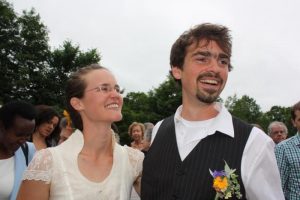
Mollie and Jake
Terry, Sierra, Skye and I wouldn’t have missed it. What fun to be in cabins in the woods, no power, running water, but to be with a wealth of family and friends and good wedding vibes. Lots of rain and forest oxygen, so cleansing and invigorating. And to boot, Terry and I visit friends in Burlington and sneak in a quick Quebec getaway.
The word Quebec comes from an Algonquin word meaning “where the river runs narrow.” In 1608 French explorer Samuel de Champlain created a colonial outpost near this narrows in what is now Quebec City. The French colony was known as New France. Then in 1763, and after a bloody seven-year war, the French turned over Quebec to the British. Canadian independence was much later secured from the Brits in the Statute of Waterloo in 1931 and the Canada Act in 1982.
Quebec is the largest province in Canada. It is 595,391 square miles in size… ten times the size of New York State (54,556 square miles), nearly four times the size of California (163,696), and twice the size of France (248,573). Quebec is the second most populous of Canada’s ten provinces, after Ontario. In 2016 its population was 8.3 million. Of these, 3.8 million people live in the Greater Montreal Area. Another 765,706 live in Quebec City, the provincial capital.
Reconnecting with Michel in Montreal
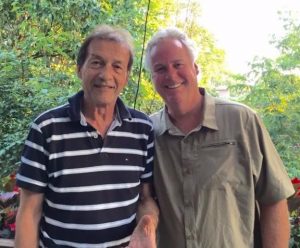 AirBNB in the old center of Montreal; hip loft, stone walls with huge beams. We wait at the sidewalk and soon the lights of an approaching car flash. Accomplished: A connection after many years. And it’s as if nothing much has happened. Michel Hannoyer had not changed a bit. He sneaks a peek in his rear view mirror and says it’s the same old Ted. We fall right back into an easy friendship.
Michel and I became friends when I was a strategic planner for the New York Power Authority and Michel was at Hydro Quebec based in its Manhattan office. His job was to sell “Power from the North” to New York utilities. This was James Bay power, tapping northern Quebec’s massive hydro potential. This was the leading edge of Prime Minister Robert Bourassa’s grand energy vision.
Michel is a Parisian with a dry humor. Retired from Hydro for some years, he’s now an aikido master in Montreal. Per our plan, he chooses a happening French restaurant (Lemeac on Laurier Street), I pay. He and his wife Andre eat blood pudding. Swapping tales of years passed, we share passions and families and travels. We laugh liberally, feel good, and agree to reconvene in three days. Then Andre cooks a scrumptious five-course meal for us on their terrace. Life is good.
The Walled City of Quebec
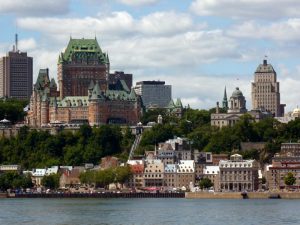 It’s a three-hour drive up the St. Lawrence to Quebec City. This city is as close as you can get to visiting Europe in North America. Fully 95% of the city’s residents speak French. The old, picturesque city is walled with wonderful arched gates. You can walk 2.6 miles on top of the wall. Considered one of the most beautiful cities in the world, it is musical, and rated number one for romance. I hadn’t been there since I was on a high school field trip to the Canadian winter carnival. Distant memories of crazy Canadian teams crossing the iceberg-choked St. Lawrence River. We watched in awe as they scrambled and moved their boats from one iceberg to another. I’ll never forget the toboggan slide in front of the iconic Chateau Frontenac.
This time, we stay just outside the wall and walk everywhere. It’s hot. The city’s alive! The annual summer music festival is in full gear. Quebecois joke that summer borrows about three weeks from winter. “Get it while it’s hot.” Everyone is out and about. There are big concert stages downtown – the largest at the Plains of Abraham where Sheryl Crow performed. Twice we see bands on the stage sponsored by Hydro Quebec. Big sound systems and happy and appreciative audiences. We sing along.
Quebec sits prominently over the Saint Lawrence Seaway, at a narrows in the seaway that connects the Great Lakes and the Atlantic. The Chateau Frontenac – originally built for Canadian Pacific railroad workers – commands a promontory position. A large promenade there features magnificent views of the river, the old part of the city, as well as the lively square near the Frontenac. We get lunch there.
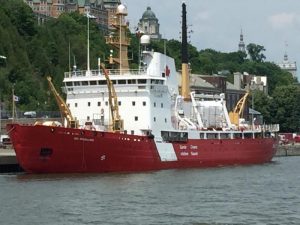 Boating on the mighty St. Lawrence, a river whose farthest headwaters are 1,900 miles away. It’s 744 miles from Lake Ontario’s outfall into the St Lawrence River northeast to the St. Lawrence Gulf. Here we are close to its end just downriver from the Ile d’Orleans. Tankers and ocean liners including the Cunard’s famed QE 2 come into the deepwater port here. Tides can be as high as 18 feet. Huge silos of grains and corn from the Canadian plains are dockside, ready for export to Europe. We pass a red ice-breaker, one of three the city uses to ride up on and crush the ice to keep shipping lanes open in winter. The St. Lawrence Seaway has been open since 1959 between the Great Lakes and the Atlantic Ocean.
There’s quite a show for sailors… a brightly colored and clearly high-tech trimaran is making a spectacle in the river, jibing downwind before us. It’s preparing for the Transat sailing race that starts the next day and that goes from Quebec City to Saint-Malo, France. We learn that this high-tech, 40-meter multi-hull ship is sponsored by the Sultanate of Oman and comes highly anticipated. Can it beat the quite experienced field? This year’s race includes boats from Quebec, France, Spain, Germany, Sweden, and Oman. With crews of 3 – 12, they expect to arrive in French waters 8 – 15 days later. The race record is 7 days, 20 hours.
Power and Water from the North
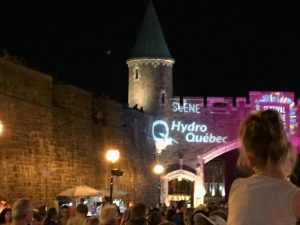 Quebec is a clean energy superpower. It runs on hydroelectricity. The province is water-rich. A half million lakes, plus mighty rivers, cover 21% of the land area of Quebec. It is the fourth largest hydroelectric producer in the world after China, Brazil, and the United States. Fully 96% of the power used in Quebec is hydro.
Visiting from drought-stricken Southwest, it’s hard not to be impressed by Quebec’s massive water resource. The forests are lush, the fields green and bountiful, rivers flush with their fresh water. Just outside of Quebec City are the Montmorency Falls. At 272 feet, the falls are 98 feet higher than Niagara Falls. We climb the 487 steps to the top. You can feel the power of this cascade. Hydro Quebec generated power here many years ago.
Quebec is also a fresh water superpower. It has a huge water resource. While a far-out idea no doubt, and fraught with reasons why not, couldn’t we pipe some of it before it heads to sea? We pipe natural gas and oil for long distances. Why not water? These pipelines would be very safe. Ripe and riparian politics for sure. But consider the value of the resource.
To fulfill much of the LA quench, we already go more than 300 miles north to the Sierras. This is done using a mixture of diversion spots, natural water channels, aqueducts, and pipes that act like gigantic siphons. By chance, we bump into John Miller, a colleague of Terry’s from LADWP. We talk water. Parsons Engineering studied piping water to LA some years ago from Alaskan. Apparently the Governor of Alaska then was happy to sell this resource south before it poured into the saltwater ocean. This transference was part of Robert Bourassa’s vision for Quebec too, shipping water south to the States.
The James Bay Region is 620 miles north of Montreal. It is the size of France… with less than 20,000 inhabitants. I visited there with Michel in 1991 when I was consulting for the Burlington Electric Department (Vermont). My analysis showed that efficiency was the least-cost resource, the most cost-effective resource option. Perhaps carbon-free, James Bay power could supplement efficiency.
Given this exceptional hydrology, the James Bay project was projected to have a whopping 27 GW potential (about 27 large nuclear plants in size). Throughout its development, the project was vehemently opposed by Cree and Inuit aboriginals. Forceful opposition by the Cree – some 5,000 strong — let to cancellation of Great Whale phase of the James Bay project. “In the end,” or at least to date, 16 GW was built at a cost of ~$20 billion USD, mostly along the La Grande River. The project involved diverting some rivers into the La Grande watershed. The area of development is equivalent to New York State.
Travelogue… Last night. AirBNB in an up and coming area – Griffintown – near downtown Montreal. The building is a condo, recently built, unfinished cement ceilings… modern and minimalistic. We park near “the foundry,” a bar with microbrews for $5 Canadian. We fuss with finding the key. Gads. Then we’re in. Quick shower and out to dinner.
Travelogue… Last morning. At Trudeau airport; reflect on week, how full. Full of family, friends – new and old, full of rain, forests, mountains, lakes, and rivers. The week’s been full of affirmations and renewed aspirations. Great cheer we had, and travelling insights we gained in Starksboro, Burlington, Montreal, and Quebec.
Sweden Test First Catenary-Powered “Electric Roadway”
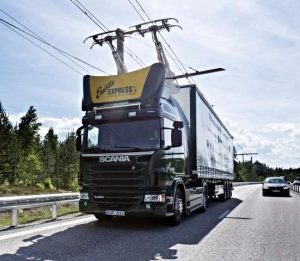
Photo: Scania
Sweden is making waves in the electric roadway space. In Sandviken on Sweden’s E16, a test stretch of electric road was inaugurated in June. The electric road will provide for active testing the use of electric power as an aid to heavy transport on public roadways. The test track is adorned with catenary lines akin to light rail systems.
The pilot test stretch on the E16 is 1.2 miles long, and utilizes catenary lines similar to those used by light rail. Its contact lines are nearly 18 feet over the roadway. The truck has a current conductor on the roof that feeds 750 volts DC to the truck’s hybrid electric system. The pilot tests are expected to continue through 2018.
Energy Efficiency in the Cockpit
McKinsey and company is known for its management consulting, and for its “supply curves” of carbon mitigation strategies. To provide a quantitative basis for GHG mitigation, McKinsey worked with ten leading global companies and organizations-The Carbon Trust, ClimateWorks, Enel, Entergy, Holcim, Honeywell, Shell, Vattenfall, Volvo, and WWF-to evaluate the costs and benefits of more than 200 abatement opportunities across 10 major sectors and 21 world regions. In its exhaustive catalog of potential energy efficiency measures is improved fuel efficiency from airlines.
A recent National Bureau of Economic Research working paper by researchers from the University of Chicago and the London School of Economics finds a significant opportunity for fuel savings in the airline industry. Researchers convinced Virgin Atlantic Airways to let them run an experiment with the airline’s captains. Could they reduce fuel use and emissions without compromising safety? At the end of the day, the researchers found a means to save the airline about $8 million a year, just through operator actions pre-flight, in-flight, and taxiing to the gate.
The researchers sent three randomly selected groups of Virgin Atlantic captains either (a) information about average fuel efficiency on the flights the captain made in the previous month, (b) the same personalized information as group (a) plus personalized targets for the coming month, or (c) personalized information and targets, plus an offer to donate 10 British pounds to a charity for each target achieved.
Pilots who only received information – group (a) – significantly improved their fuel efficiency, while pilots who received personalized targets improved their fuel efficiency even more, achieving about the same gains as the pilots who could donate savings bonuses to charity. Even pilots in the control group improved their fuel efficiency, an example of the Hawthorne Effect that suggests that people behave differently when they know they’re being studied.
The pilot adjustments netted Virgin $5.4 million in fuel savings over the eight-month pilot period. And, since the costs of running the experiment were very low – less than $3,000 to send a couple hundred letters a month – this appears to be an example of a negative cost abatement strategy. The authors calculate approximately -$250 per ton of CO2, negative, since the company saved money.
So, what adjustments did these super-humans make to save fuel? For example, when they’re taxiing, pilots are usually supposed to turn off half of the engines. Before the experiment, pilots did this on 35% of the flights, and after they knew they were being observed, this increased to 51%. Other adjustments involved following advice from air traffic control about more efficient routes or using real-time information about the baggage onboard to adjust fuel levels.
As the researchers point out, providing feedback to the pilots involved large amounts of data (on over 40,000 flights), which were collected, quickly analyzed and sent to the pilots. While the fuel savings are decent sized and statistically significant, they amount to small tweaks to the way an industry does business.
Lowline: New York’s Underground Park

Visitors at the Lowline Tech Demo
New York City officials just approved plans to build the world’s first underground park! The Lowline park will be located in an abandoned subterranean train line in NYC’s Lower East Side. Daylighting using fiberoptic cables and mirrors will pump sunlight underground to sustain a flourishing underground forest measuring a full acre in size.
Last year its proponents — Ramsey and Barasch — opened a lab and technical exhibition — the Lowline Lab — to introduce the project to the public. Over 70,000 people attended. The lab has been testing lighting technology for growing plants underground, water collection systems, and ways to regulate air temperature. Lowline will offer an inverse counterpart to the West Side’s much-celebrated Highline, which is built on a raised railway trestle.
Now that NYC officials have given the Lowline the green light, the park’s organizers have 12 months to raise $10 million, conduct community outreach, finalize the design, and submit detailed plans for further approval. All told, it’s expected to cost $60 million to build.
Paris in the Lead on Mobility and Emissions
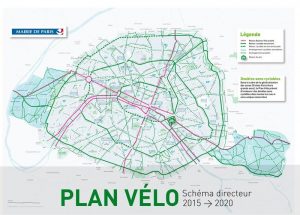
Photo Credit: Paris Mayor’s Office
Two big carbon mitigation measures are in gear in Paris. First, the City has banned all cars pre-1997 for weekday travel. Second, the City is building a 26-mile bicycle superhighway.
Paris just officially banned all pre-1997 model automobiles from driving in the city center on weekdays. This ban affects roughly a half million vehicle owners and was conceived to reduce air pollution and smog in the French capital. While older vehicles represent approximately 10% of the city’s vehicle stock, they account for nearly half of all emissions in Paris.
Paris just inaugurated its very first all-bike superhighway. So far, the thoroughfare consists of a half-mile stretch of pavement, but by 2020 it will be just one small part of a 28-mile bicycle highway network, called the Réseau Express Vélo (“REVe”). Rather than placing bike lanes on already-busy streets, Paris has opted to build dedicated bike paths free of motorized vehicles to encourage those too timid to travel in urban traffic.
How Hot are LEDs?
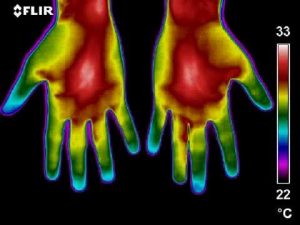 LEDs don’t produce heat? Is this fact or fiction” Answer: Light Emitting Diode lights do not get hot enough to burn a person or melt a surface. In fact, an LED bulb that has been on for days can be unscrewed with bare hands.
In one sense this is fact: LEDs are cool to the touch because they generally don’t produce heat in the form of infrared radiation (IR). IR heats the enclosures and surroundings of incandescent bulbs and other sources, making them hot to the touch.
For LEDs, without IR, heat is produced within the LED device itself, due to the inefficiency of the semiconductor processes that generate light. The wall-plug efficiency (optical power out divided by electrical power in) of LED packages is typically in the region of 5 – 40%, meaning that somewhere between 60 and 95% of the input power is lost as heat.
For example, the energy consumed by a 100-watt incandescent bulb produces around 12% heat, 83%, IR and only 5% visible light. In contrast, a typical LED might produce15% visible light and 85% heat. Especially with high-power LEDs, it is essential to remove this heat through efficient thermal management.
Intersolar and EES in San Francisco
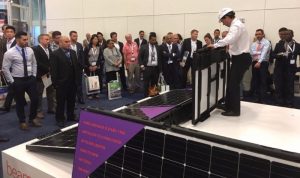
Beamreach Solar’s Sprint Demonstration
Familiar with the term Distributed Energy Resources? DER includes renewables and energy storage. What a match! Solar provides the ITC credit for storage; storage extends and multiplies the benefits of renewable generation. At InterSolar, Michael Ware and Drew Lowell-Britt feast on presentations and exhibitions of the latest DER technologies.
There are unquestionably many benefits of combined solar and storage: improved grid reliability, transmission congestion relief, reduced demand charges, reduced peak pricing charges, and overcoming net metering restrictions. Given advanced technology, storage is growing. The U.S. market is expected to deploy 2,081 MW by 2021, nine times more than in 2015. The greatest growth is expected to occur behind the meter. And storage costs are falling, great news when falling solar prices may be bottoming out. Battery prices have declined 80% over the last six years and total costs are projected to decline more than 40% over the next five years.
There is a growing market for third party financed energy storage that delivers shared savings for hosts and owners. Companies like Green Charge Networks and Gexpro lead the charge. There are many energy storage players are in the residential market including SolarCity/Tesla, Sonnen, Outback, Swell, Sunverge, and EliiyPower.
 Software is key to controlling the mix. Software driven companies like Sonnen and Adarra are recruiting photovoltaic installers to amend their offers with energy storage. There is all sorts of mixing and matching: Sonnen systems may include Outback inverters and Samsung batteries, but the brains are in its software. The software is critical for discharging the batteries at opportune times to save high peak energy rates or keep critical loads powered during grid outage. Adarra is training installers to properly design and install critical load subpanels that integrate backup storage into a household. DER is alive and well. We look forward to combining solar and energy storage strategies for clients.
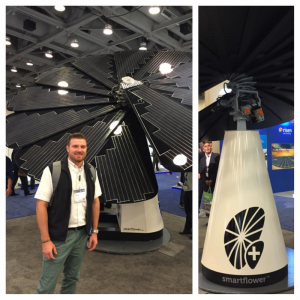
The Intersolar/EES conference and expo had about 550 vendors and 18,000 attendees, occupying all three floors of the Moscone Center West. The “Smartflower” really stood out from the crowd. The new Austrian invention got a plug (via video) from the former Governator himself, Arnold Schwarzenegger. The 2.51 kW of “solar pedals” open up in the morning, follows the sun throughout the day and closes at night. The standard 2-axis tracking allows the system to produce 5,880 kWh annually (when installed in the Southern California region). The opening and closing cleans the array with soft bristle brushes on each pedal and it will close itself automatically in high winds. With six colors to choose from and a cost of $16,900, you may see them coming to a yard in your neighborhood soon.